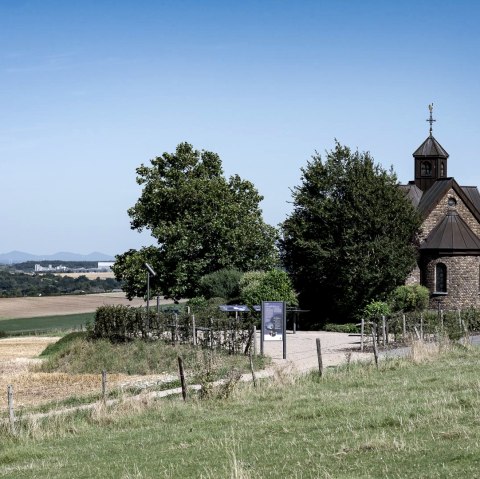

Bruder Klaus Kapelle, © Nordeifel Tourismus

Bruder Klaus Kapelle

Mechernich

The field chapel dedicated to St. Nicholas of the Flüe - called Brother Klaus - is a privately donated and built chapel, a place of silence, meditation and prayer.  Anyone who visits them with this intention is very welcome. May many people find a way to God in this place!

 The chapel is modelled on the hermitage of Brother Klaus and is therefore not suitable for large groups of visitors.  Pilgrim groups with more than ten people are therefore requested to register in advance. The field chapel is not intended as a destination for people interested exclusively in architecture.  The field chapel can only be reached on foot in 10 to 15 minutes via a slightly ascending path. Parking for cars is only possible in the signposted car park on the outskirts of Wachendorf in the direction of Lessenich


mehr lesen

Share content:

At a glance

Opening hours

  • From April 1st to October 1st
    Tuesday
    10:00 AM - 5:00 PM

    Wednesday
    10:00 AM - 5:00 PM

    Thursday
    10:00 AM - 5:00 PM

    Friday
    10:00 AM - 5:00 PM

    Saturday
    10:00 AM - 5:00 PM

    Sunday
    10:00 AM - 5:00 PM

April to October from 10:00 AM to 5:00 PM
November to March from 10:00 AM to 4:00 PM

On Mondays the chapel is closed - except on Easter, Pentecost, and Christmas.

On Christmas Day and New Year's Day, the chapel is open from 10:00 AM to 4:00 PM.

Place

Mechernich

Contact

Bruder-Klaus-Kapelle
Iversheimer Straße
53894 Mechernich
Phone: (0049) 2256 7127

Homepagewrite e-mail

Bitte akzeptieren Sie den Einsatz aller Cookies, um den Inhalt dieser Seite sehen zu können.

Alle Cookies Freigeben

Plan your journey

per Google Maps

You might also be interested in

Urfttalsperre im Morgenlicht, © Eifel Tourismus GmbH, Dominik Ketz

Urfttalsperre

The Urft Dam is the oldest valley dam in the Eifel and is located in the middle of the Eifel National Park. At the time, the dam was planned as the largest structure in Europe. Construction of the 266 m long wall made of quarry stones began in 1899 - in May 1905 the dam was filled with water for the first time. In addition to flood protection and energy generation, the aim of the hydraulic engineering measure was to supply the region with drinking water. With a length of 12 km, a width of up to 1 km and a maximum depth of 52 m, Lake Urft has a capacity of 45.5 million cubic metres. Translated with www.DeepL.com/Translator (free version)

Burg Langendorf, © Paul Meixner

Burg Langendorf

Langendorf Castle was first mentioned in 1240. The oldest part of the main building dates back to the 15th century and was expanded around 1498 to include the courtrooms. The castle has been in family ownership since 1880 and was passed on to the then-20-year-old heir Manfred Vetter in 1957 - with the aim of restoring and revitalizing the heavily damaged castle. “Concert in the Barn” - from 1994 to 2010, more than 120 concerts featuring young musicians took place in the barn of the castle. The international historical fire helmet collection with approximately 300 helmets was incorporated into the foundation in 2010. The open-air stage, used only ten times, was donated to the Euskirchen district at the end of 2010 for events by schools, clubs, and others. The castle (cellar ground floor and outside) is available for group tours by arrangement.