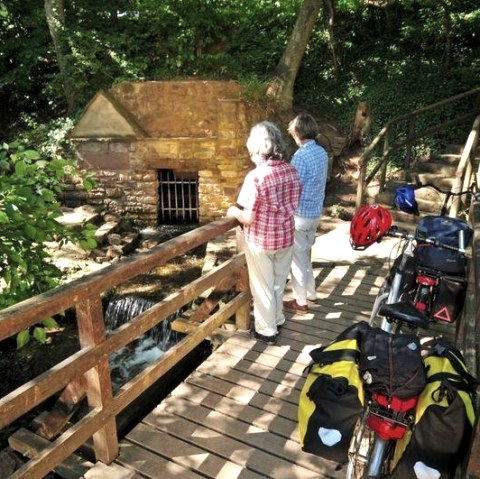

Kyll valley, © Eifel Tourismus, Dominik Ketz

Kylltal

Hellenthal

The Kyll Valley is a quiet, yet multifaceted backbone of the Eifel – a landscape that does not impose itself but unfolds depth with every step and every glance along the water. The Kyll springs inconspicuously at about 660 meters above sea level at the Losheimer Graben in the Kalkeifel, where moist meadows, basalt soils, and cool forest air shape the character of the region. From here, it embarks on its approximately 130-kilometer journey southward, through the Vulkaneifel and the Prümer Kalkmulde, past Gerolstein, Kyllburg, and Bitburg, before calmly and unceremoniously flowing into the Moselle at Trier-Ehrang.

What distinguishes the Kyll Valley is its interplay of natural history and cultural landscape. Over millennia, the river has burrowed deeply into the rock layers, cutting through dolomite, limestone, and volcanic deposits, forming a narrow, at times almost gorge-like valley, continually opened by broad floodplains, rocky outcrops, and wooded slopes. Along the Kyll lie railroad tracks from the 19th century, traces of Roman settlements, medieval castles, and small towns, whose rhythm is still determined by the water.

Characteristic of the valley is its calm, linear course: not a dramatic spectacle, but a continuous journey that allows for perception. The Kyll is the longest river in the Eifel and also the richest in water for the southern Eifel. It serves as a habitat for trout, water ouzels, and kingfishers, accompanying hikers and cyclists with a steady, almost meditatively flowing course. Those who follow the valley experience the Eifel in one of its most honest forms – geologically shaped, historically grown, and to this day remarkably unspoiled.

mehr lesen

Share content:

At a glance

Opening hours

  • From January 26th to December 31st
    Monday
    00:00 - 23:59

    Tuesday
    00:00 - 23:59

    Wednesday
    00:00 - 23:59

    Thursday
    00:00 - 23:59

    Friday
    00:00 - 23:59

    Saturday
    00:00 - 23:59

    Sunday
    00:00 - 23:59

Place

Hellenthal

Contact

Die Kyll
An der B265
53940 Losheimergraben

Bitte akzeptieren Sie den Einsatz aller Cookies, um den Inhalt dieser Seite sehen zu können.

Alle Cookies Freigeben

Plan your journey

per Google Maps

You might also be interested in

Cyclists at the source of the Erft

Erftquelle

The "Erft" rises in the small village of Holzmülheim, directly below the Himberg. It flows from here in the direction of Bad Münstereifel until it flows into the Rhine after about 100 km near Neuss. The spring was framed with natural stones by the village community.There is also a small statue of St. John Nepomuk, who is venerated as a bridge saint and is supposed to protect against water hazards. In the immediate vicinity is a playground, where there are also barbecue facilities and a lawn for sunbathing. At events at the spring, there is the possibility of being baptised in the Erft and receiving the title of "Erft cadet".

Langendorf Castle, © Paul Meixner

Burg Langendorf

Langendorf Castle was first mentioned in 1240. The oldest part of the main building dates back to the 15th century and was expanded around 1498 to include the courtrooms. The castle has been in family ownership since 1880 and was passed on to the then-20-year-old heir Manfred Vetter in 1957 - with the aim of restoring and revitalizing the heavily damaged castle. “Concert in the Barn” - from 1994 to 2010, more than 120 concerts featuring young musicians took place in the barn of the castle. The international historical fire helmet collection with approximately 300 helmets was incorporated into the foundation in 2010. The open-air stage, used only ten times, was donated to the Euskirchen district at the end of 2010 for events by schools, clubs, and others. The castle (cellar ground floor and outside) is available for group tours by arrangement.