
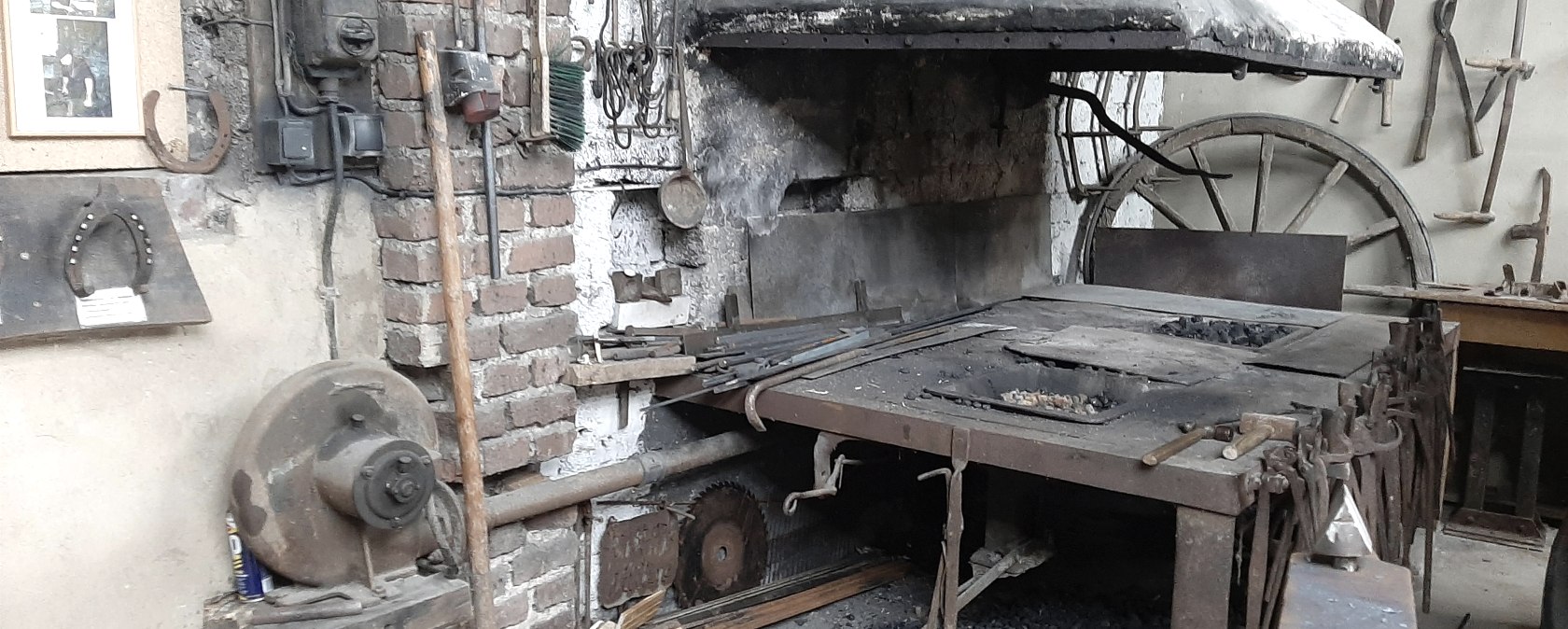
Old Blacksmith's Shop, © Hans-Peter Ronig

Alte Schmiede

Schleiden

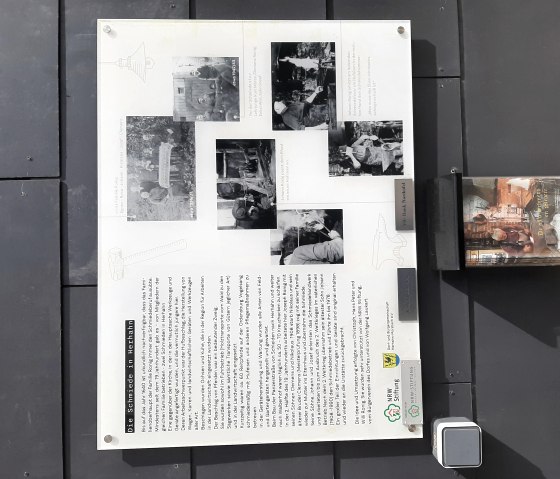
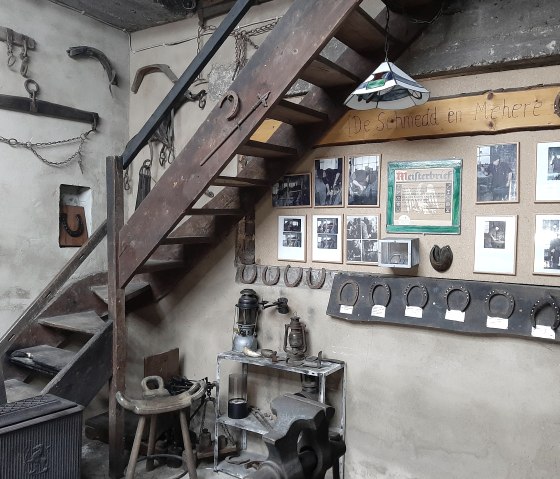
In Herhahn, the Ronig blacksmith family looks back on an impressive history that can be traced back to the year 1650. The blacksmithing craft has been passed down through many generations in the family. The last active blacksmith was Johann Ronig, a passionate farrier and horse expert.

In his workshop, he produced, among other things, wagons, harrows, plows, and numerous agricultural tools. However, with the increasing automation and industrial production in the 1950s, the traditional craft became less and less in demand. In 1978, the forge finally closed its doors.

After many years as a storage room and garage, the historic workshop was rediscovered. The approximately 100-year-old building with its distinctive architecture and the former smoke chamber above the forge still tells of a time when the blacksmithing craft was part of everyday village life.
mehr lesen

Share content:

At a glance

Opening hours

please inquire by phone

Place

Schleiden

Contact

Alte Schmiede
Herhahn 15
53937 Schleiden-Herhahn
Phone: +49 2444 452

Homepagewrite e-mail

Bitte akzeptieren Sie den Einsatz aller Cookies, um den Inhalt dieser Seite sehen zu können.

Alle Cookies Freigeben

Plan your journey

per Google Maps

You might also be interested in

LVR Industrial Museum / Müller Cloth Factory, Euskirchen, © Tourismus NRW e.V.

LVR-Industriemuseum / Tuchfabrik Müller

It is a journey back in time to the world of the cloth industry. In 1961, factory owner Kurt Müller closed the doors of his cloth factory in the Eifel, hoping to reopen it soon. This did not come true, but today visitors can take a unique tour of a factory where robust woollen fabrics and loden cloth were produced for many years. They are immersed in the world of dyeing and weaving and experience how some of the machines are brought back to life during a guided tour and how people used to work here.

Urft dam in the morning light, © Eifel Tourismus GmbH, Dominik Ketz

Urfttalsperre

The Urft Dam is the oldest valley dam in the Eifel and is located in the middle of the Eifel National Park. At the time, the dam was planned as the largest structure in Europe. Construction of the 266 m long wall made of quarry stones began in 1899 - in May 1905 the dam was filled with water for the first time. In addition to flood protection and energy generation, the aim of the hydraulic engineering measure was to supply the region with drinking water. With a length of 12 km, a width of up to 1 km and a maximum depth of 52 m, Lake Urft has a capacity of 45.5 million cubic metres. Translated with www.DeepL.com/Translator (free version)