Vortrag von Dr. Dorothea Eimert
Oct 7, 2026
Zülpich
Franz Marc belongs to the creative generation of artists before the First World War, to whom the revolutionary step from image to meaning is attributed. He and his friends from the Blue Rider fell under the spell of new knowledge in the natural sciences, turning away from the deceptive appearance of the surface to found the powerful laws behind it. “The decay of the atom was, for my soul, equivalent to the decay of the whole world,” wrote Franz Marc. He had to experience that there was no longer any matter, but only forces, movements, and energies. He recognized the unifying harmony of all being that governs everything. “Everything is one,” he noted. The artistic approach of the Blue Rider was philosophical. It was about transcendence. Art was created out of inner necessity, from a pantheistic empathy for nature. Their philosophical stance was to create a visible reality from the invisible and the intangible, which inevitably led to non-representation. Franz Marc fell in 1916 in the war. He left us a message that eloquently speaks of the harmony of all beings and of oneness with nature and all living things. In the "Degenerate Art" exhibition in 1937 in Munich, the Nazis removed his paintings because the viewers stood before them too reverently.
Dr. Dorothea Eimert studied art history at the University of Cologne, where she received her doctorate in 1973 with the topic “The Influence of Futurism on German Painting.” From 1974 to 1978, she was a research assistant at the Leopold Hoesch Museum in Düren and served as its director from 1978 until her retirement at the end of 2009. From 1990, she was also the director of the Paper Museum Düren, which she initiated and developed in collaboration with the regional and national paper industry. From the combination of art museum and technical paper museum, she developed the PaperART, to which international artists were regularly invited. Three art foundations were affiliated with the museums during her time – the Hubertus Schoeller Foundation, the Zilcken Foundation, and the Günther Peill Foundation, with whose support the extension of the Leopold Hoesch Museum could be realized. For her great commitment to the cultural foundations in Düren, she was awarded the Federal Cross of Merit in 2011.
The places are unfortunately limited and will be allocated on a first-come, first-served basis.
We look forward to your presence and an inspiring evening.
Time: 7.00 p.m., 6.30 p.m. Entrance
Costs: 5€
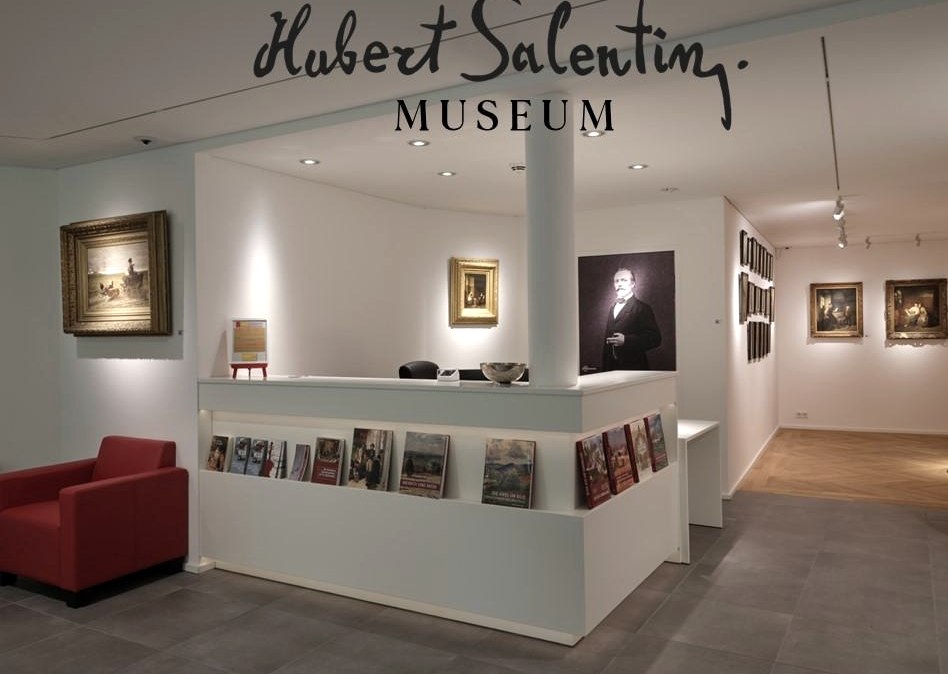
Location: Zülpich, Hubert Salentin Museum, Kölnstr. 2
Email: info@hubert-salentin-museum.de
Registration by email required by 01.10.!