
Museumssägewerk Zweifall
Stolberg
General Information about the Museum
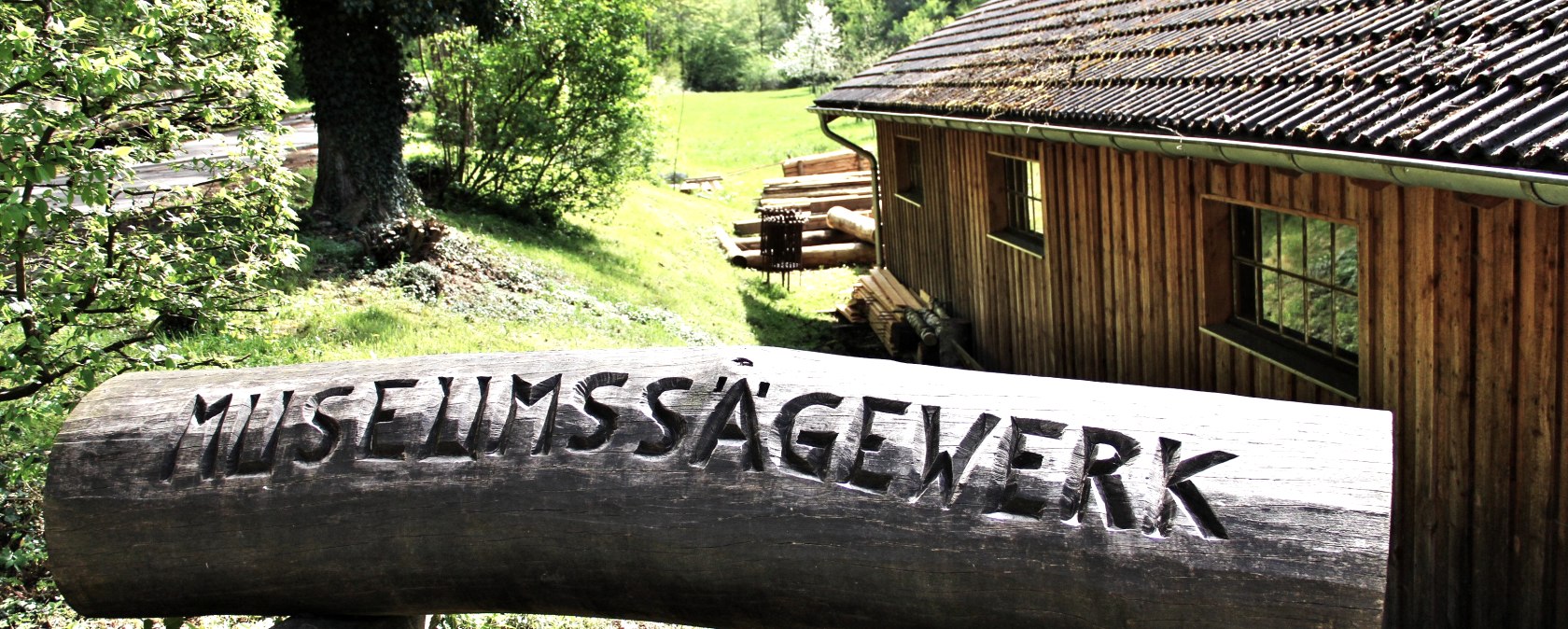
In 2002, local residents of Zweifall decided, in cooperation with the then Forestry Office Hürtgenwald, to find a home for proven, old sawmill technology. Instead of being scrapped, a sawmill and a bandsaw found a new home in the current museum sawmill at the Forsthaus Zweifall.
Two partners are collaborating on this project: the State Operation Forest and Wood NRW - Regional Forestry Office Rureifel-Jülicher Börde, which provides the land and the building, and the Förderverein Museumssägewerk Zweifall e.V., founded in autumn 2008, which aims to financially support the sawmill and demonstrate old sawmill techniques to the public. Volunteers oversee operations and demonstrate the saws.
In the Exhibition Room:
Why the location Zweifall? (Image panels with Zweifall sawmills)
Zweifall has always been shaped in its economic development by the surrounding forest, with many families deriving their income from the woods. Timber trade and wood processing were established here. In the mid-19th century, sawmills were powered by water or steam; this was followed by the use of gas engines and eventually electricity. Of the formerly up to ten sawmills in the village of Zweifall, two are still active today.
Felling trees: (Images of hand saws, two-man chainsaws, development of the one-man chainsaw [EMS])
Traditionally, in the past, felling was done by two men using a sharp felling axe to make the notch, and subsequently, the felling cut was made with a hand saw. After World War II, motorized two-man chainsaws were developed that, despite their enormous weight (45 kg), significantly facilitated felling operations. The further development led to the one-man chainsaw (EMS), whose weight decreased from 7-8, occasionally 12 kg to currently 3-4 kg. With the introduction of this technology, productivity in logging increased, and the ergonomic strain on workers involved in the still demanding wood harvesting work was further reduced.
Measuring wood: (Measuring tools)
After felling, the tree is stripped of its branches and cut into saleable lengths. These are measured by length and middle diameter for calculating the log volume.
Length measurement using a caliper measuring stick or tape measure; diameter with a caliper
Numbering wood (Numbering tools)
Length and diameter are written with a sequential number on the end face of the measured log: e.g.: 1362 12/35 [12 m long; 35 cm diameter].
Previously, the numbers were stamped with a numbering hammer using printer's ink; today, plastic tags with a running number are used.
This data serves as the basis for creating wood lists for the sale of the product to the sawmills.
Transporting wood (Images of horses and trucks)
Cut and measured wood was previously pulled by animals (horses or oxen) along forest paths and drawn over inclined planes onto wooden carts with the pulling power of the animals. Transport to the sawmill was also done by horse (draft horses). Even heavy hardwoods were transported to the mill piece by piece. With the advent of motors and winches, animals were also replaced by motor power in this area.
Metal fragments in the wood (Exhibits with fragments/cabinet)
The Second World War left its mark on the trees that are now 60 years old or older. Coming from the Belgian coast, the Americans occupied Zweifall in mid-September 1944. The Hürtgenwald, occupied by German soldiers, turned out to be an unexpectedly difficult barrier to penetrate. The forest suffered greatly. It was shot at from both sides. Old stocks that survived the war usually show metal fragments, which, although eventually grown into the wood, caused significant damage to the saw blades during the wood cutting process in the mill.
In the Demonstration Room:
Frame Saw
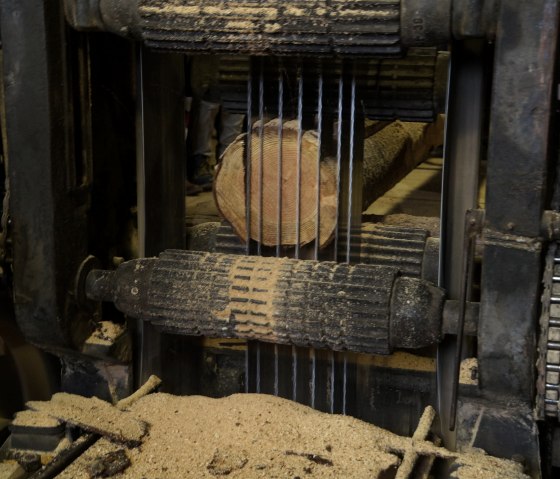
The frame saw dates back to 1934 and was built in Aue/Saxony. During the war, it could even be used mobile, powered by a tractor. The drive is provided by a powerful electric motor. The belt drive is transmitted to the flywheel of the saw through a transmission. With a constant feed, the logs are sawed into beams or boards.
Most recently, the frame saw served for many years in the sawmill of the late Hein Groß in Mulartshütte.
Bandsaw from 1936
The last operational location of this saw was the carpentry of Helmut Sonntag (†) in Zweifall.
With the help of the bandsaw, the boards or planks cut at the frame are trimmed, so that the so-called "forest edge" is removed.
- Open from Easter Sunday to 25 October, every Sunday from 11 am to 4 pm
- Advent saws with Christmas bazaar, game sale, and culinary treats on Sunday, 29 November 2026
Frame saw demonstrations on every 3rd Saturday of the month (no registration required):
- 18 April 2026
- 16 May 2026
- 20 June 2026
- 18 July 2026
- 15 August 2026
- 19 September 2026
- 17 October 2026