
Albertsgrube
Stolberg
Ore washing, ore processing, and tailings piles
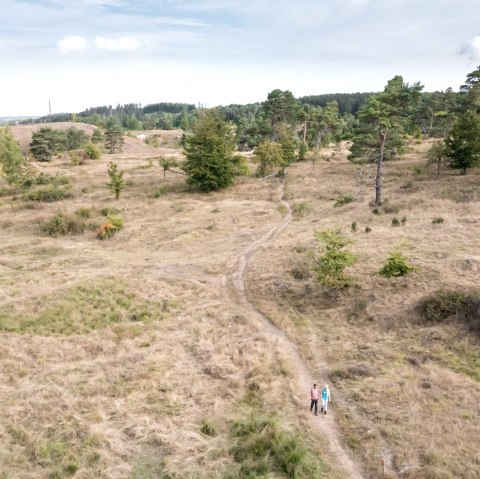
This area housed the ore washing and processing facilities as well as the waste rock dump for the original section of the Albertsgrube (tunnels I–VII and the Eisensteinschacht shaft). The tube-like extension located in the southeast represents the concession for the Zufriedenheit Mine from 1829. Both mines were merged into the Albertsgrube in 1847.
Of the processing plant built in 1853, the four settling ponds still remain. Since separating the ore from waste rock using density sorting was not particularly effective, significant amounts of ore still remained in the waste rock. This explains why the waste rock pile is not overgrown—or is overgrown only by calamine flora and other heavy-metal-tolerant plants.
Since pine and birch trees, among others, are also tolerant of heavy metals, there is a risk of the tailings pile becoming overgrown with forest, which would lead to the disappearance of the calamine flora. Unlike in the Zufriedenheit and Diepenlinchen areas, lead sulfide (galena) and iron sulfide (pyrite/marcasite) predominate here. The water needed for density sorting was collected uphill in ponds that still exist today and, after clarification in the slurry pits and settling ponds, was discharged into the Quellbach stream. This kept water pollution from sludge to a minimum.
The resulting sludge was also dumped onto the tailings pile. Even today, the bed of the Quellbach stream is rust-red in color; however, this has nothing to do with ore washing but is caused by the leaching of iron oxide from the mine’s tunnels and shafts.
Processing by density sorting (gravity separation): The mined ores exhibit sufficiently large differences in weight compared to the waste rock, making separation by specific gravity possible. To this end, the waste rock is crushed (in a crushing plant) and then sent over gently sloped, vibrating tables (shaking tables). This shaking takes place under a gentle stream of water, so that the lighter waste rock is washed away and the heavier ore remains behind.
(Text: Jens Mieckley)
This route was developed as part of the LEADER-funded project “Quality Initiative for Hiking in Roetgen and Stolberg” with support from the European Union (EAFRD) and the state of North Rhine-Westphalia.